
Par Audrey-Rose Turgeon
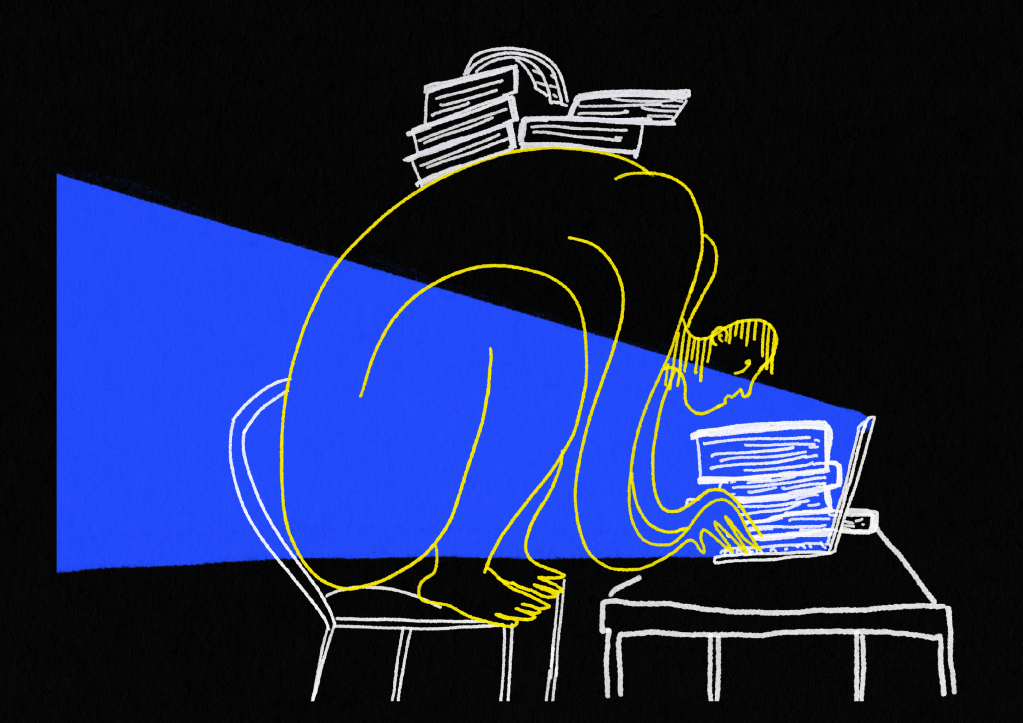
Bien qu’on sache tous qu’il est important de prendre des pauses pendant une séance de travail, dans le moment, il est facile d’en faire abstraction par peur de décrocher de notre profonde concentration qui a été si difficile à gagner ou par peur de perdre du temps, pour finalement être complètement vidé.e cognitivement après 3 ou 4h de travail (je parle ici d’expérience personnelle). Pourtant, les pauses, lorsque bien faites, ont un effet significatif sur l’énergie à travers la journée et sont des alliées précieuses pour notre concentration, notre productivité et notre bien-être1, et ce, bien au-delà de ce que l’on pourrait croire. Je vous partage ici quelques informations dont vous pourrez vous servir pour votre prochaine séance d’étude intensive, mais aussi lors de vos cours.
Quand s’arrêter?
À quel moment sait-on qu’on a besoin de s’accorder un répit? Tous ne s’entendent pas sur la durée idéale d’une période de travail et c’est bien normal : cela varie d’une personne et d’une journée à l’autre. Vous êtes sûrement bien familier.ère.s avec la technique Pomodoro et ses variantes dont la formule classique implique 25 minutes de travail suivies de 5 minutes de pause. Bien qu’elle soit efficace pour contrer la procrastination, 25 minutes ne sont parfois pas suffisantes pour entrer dans un état de flow, puis lorsque l’on interrompt cet état, on gaspille du temps et de l’énergie à essayer de s’y replonger. L’idéal serait de ne pas respecter une période prédéfinie de temps et de plutôt y aller en fonction de nos ressources cognitives cette journée-là. On en revient donc à la question de départ : comment savoir quand il faut s’arrêter? Le moment optimal pour s’accorder une pause serait une fois que l’on est dans l’état de flow, lorsqu’on sent notre concentration commencer à faiblir et notre esprit commencer à vagabonder. Mais attention à ne pas se rendre au stade de fatigue! Si l’on se sent fatigué.e, c’est parce qu’il est déjà trop tard pour renouveler notre énergie.2 Très bien, maintenant, c’est l’heure de la pause! Comment fait-on en sorte que la pause soit régénérative et que l’on consomme le moins d’énergie possible pour retrouver notre état de flow une fois qu’il est temps de se remettre à la tâche?
Quoi faire durant sa pause?
Malgré qu’il puisse être tentant de profiter de sa pause pour répondre à ses derniers messages (je le dis parce que je suis la première à tomber dans le piège), c’est l’erreur à ne pas commettre si l’on veut recharger ses capacités mentales.3 En fait, pour une pause efficace, l’idéal est de faire une activité qui permet de demeurer dans un état similaire à notre état de flow pour ne pas dépenser trop d’énergie à essayer de retrouver cet état, tout en accordant un arrêt total à son cerveau.4 Comment? En faisant une activité qui permet de se centrer sur son corps ou sur ses sens et de ne penser à rien, comme marcher, s’étirer, faire du rangement, faire un exercice de respiration ou monter et descendre un escalier.5 Privilégiez une activité qui vous plaît et planifiez celle-ci à l’avance pour réduire la charge cognitive une fois la pause venue. En effet, passer au moins 3 à 5 minutes 4 à 5 fois par jour sans aucune sollicitation cognitive est primordial pour protéger la sécrétion d’orexine, ou hypocrétine, l’un des neuropeptides les plus importants dans le maintien de l’attention, qui permet aussi notamment une meilleure régulation de l’humeur et du sommeil. De plus, les pauses actives se doivent d’être privilégiées, car faire de l’exercice modéré pendant au moins 1 à 3 minutes toutes les 90 minutes, combiné à 30 minutes d’activité cardio modérée 5 fois par semaine, permet de contrer le ralentissement métabolique associé au mode de vie sédentaire. Ceci est important, car la capacité d’attention d’une personne en ralentissement métabolique est de 47 secondes!6 Finalement, vous pouvez profiter de vos pauses pour bien vous hydrater et faire le plein de nutriments. Conseil évident, mais primordial pour la concentration et le bien-être de nos neurones qui travaillent si fort!
J’espère que ce texte vous aura permis de vous sentir un peu plus outillé.e.s pour vos prochaines séances d’étude. Sur ce, je vais prendre une pause! Bonne étude!
Références
- Kühnel, J., Zacher, H., de Bloom, J. et Bledow, R. (2017). Take a break! Benefits of sleep and short breaks for daily work engagement, European Journal of Work and Organizational Psychology, 26:4, 481-491, DOI: 10.1080/1359432X.2016.1269750
- Shilton, A.C. (2023, 3 février). Gervais, L.-M. (2013, 2 février).How to Tell If Your Brain Needs a Break. New York Times. How a Brain Break Can Increase Focus and Productivity – The New York Times (nytimes.com)
- Kang, S. et Kurtzberg, T.R. (2019) Reach for your cell phone at your own risk: The cognitive costs of media choice for breaks. Journal of Behavioral Addictions, 8(3), 395-403. DOI: 10.1556/2006.8.2019.21
- Pendem, P., Green, P., Staats, B.R., et Gino, F. (2016). « The Microstructure of Work: How Unexpected Breaks Let You Rest, but Not Lose Focus. » Harvard Business School Working Paper, 17(58). https://dash.harvard.edu/bitstream/handle/1/30004148/17-058.pdf?sequence=1&isAllowed=y
- Sianoja, M., Syrek, C.J., de Bloom, J., Korpela, K. et Kinnunen, U. (2017). Enhancing Daily Well-Being at Work Through Lunchtime Park Walks and Relaxation Exercises: Recovery Experiences as Mediators. Journal of Occupational Health Psychology, 3(23), 428-442. http://dx.doi.org/10.1037/ocp0000083
- Thibeault, R. (2023, 1er février). Construire sa résilience en contexte de surcharge : stratégies physiologiques, cognitives et systémiques [Webinaire]. FMSQ. https://fmsqprod.myabsorb.ca
Corrigé par Valérie Caron, Charlene Allaire et Ariane Pomerleau
Révisé par Florence Grenier
Illustration originale par Mariam Ag Bazet
 Le Psy-Curieux